
A Paris Guide
St. Germain
St. Germain
|
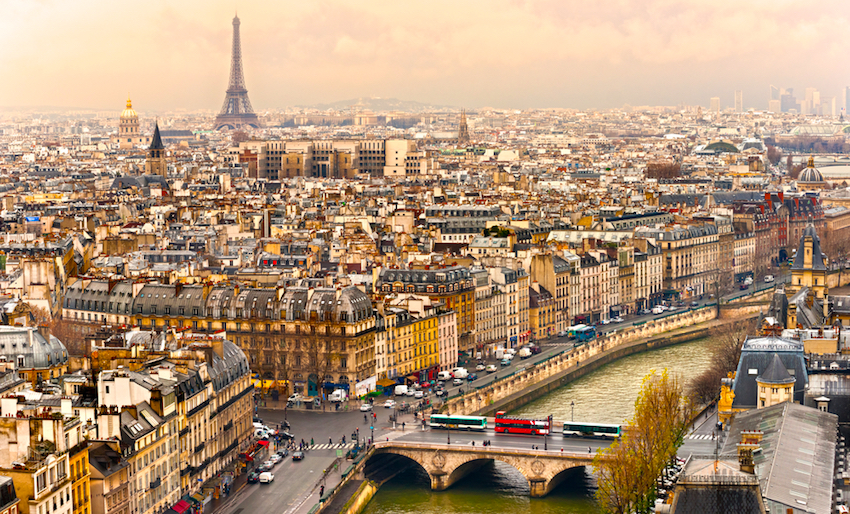
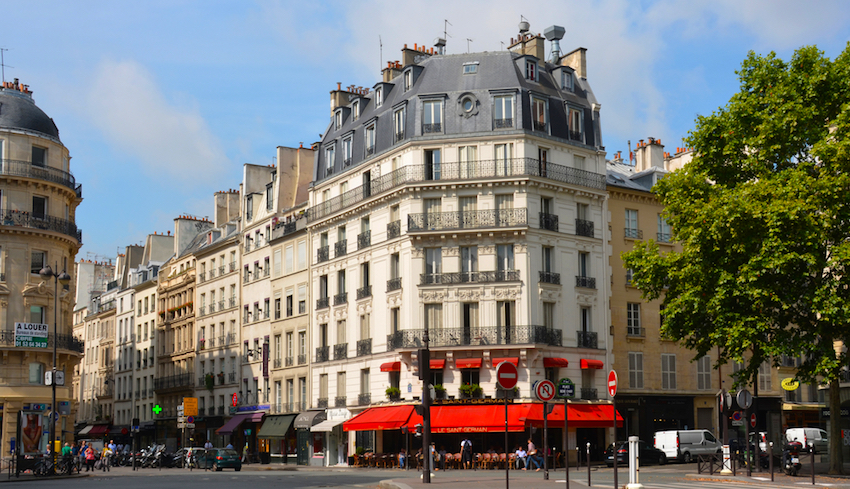
St. Germain is inextricably linked to the historic center of French intellectualism as Medieval Europe's center of education when Latin was still the Lingua Franca. It was also the left bank's answer to the painter's haven of Montmartre. The times have changed and while Francois Villon has long vanished from the dark riverbanks, J.P Sartre no longer keeps office hours in the local cafés, Alberto Giacometti and Samuel Beckett no longer stroll the Boulevard St. Germain and black American Jazz masters no longer haunt the late night dives, St. Germain is still blessed by a youthful energy, interesting streets and the atmosphere that accompanies a living university district. |
|
Yes, the gritty feel of it's original
streets and crowded bars has long since given in
to a wave of tourist-inspired gift shops, fake
Greek eateries run by North Africans,
pseudo-Irish, pseudo-Salsa, pseudo-everything
bars--- but one has to fight the temptation to
grow bitter. Certain traditional Parisians refuse
to associate with the neighborhood in the same way
they avert their gaze when passing the glass
pyramids of the Louvre. Tradition has been
damaged, but traditions are constantly being
renewed (we hope), and oxymoronic as that may
sound, it is the only way countries built on
complex and much-scrutinized histories assert
themselves as modern players. The area is not
limited to students, bars and tourists. As a
center for bookstores, design shops, museums,
churches, high-end art galleries, boutique hotels,
historic cafés and restaurants, it is virtually
impossible to be disappointed. To paraphrase
Samuel Johnson with a twist--- if you are bored in
St. Germain, you are bored with life. |
|
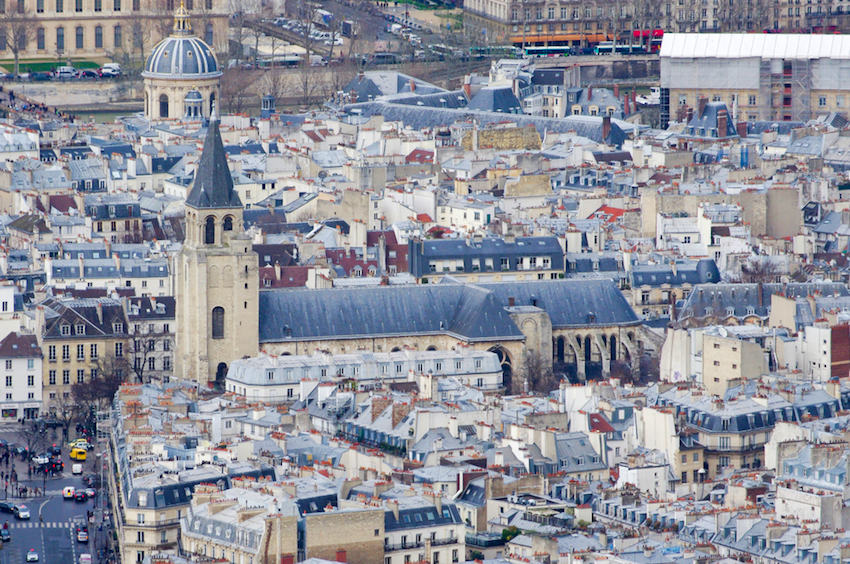
The official "center" of the area is the church of St. Germain des Prés (metro St. Germain des Prés). The original foundations were laid in the 3d century A.D. but the church standing today was built in 1163 and is the remnant of what was once a rather large monastery complex. Visible remains can be seen in the ivy-covered areas inside the wrought iron fence that surrounds the building. The interior is a good example of the painted Gothic style and on certain days, usually religious holidays, classical concerts are performed in the candlelit interior. |
|
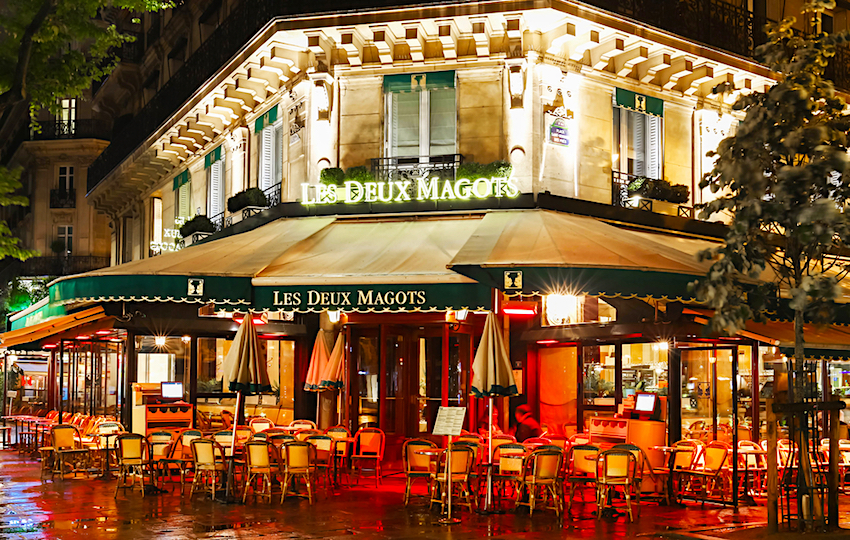
Facing the square is the Café Les Deux Magots, (I call it, the two maggots, but don't do that) possibly the most famous left bank café along with the Café de Flore which is just around the corner on the Boulevard St. Germain. (Hemmingway, Sartre and Simone de Beauvoirall frequented the Deux Magots, whereas Picasso liked the Flore ) You can stare at the trendy artsy-fartsy types and the cell-phone-obsessed businessmen with beautiful (and very bored) girlfriends in the windows, or go in yourself and order a vin blanc or a five-euro coffee. In warm weather, the sidewalk tables are filled, but if you want to see good looking people walking around and funny dogs in various new dog accoutrements, get a table and try to look preoccupied with your own brilliant thoughts. |
|
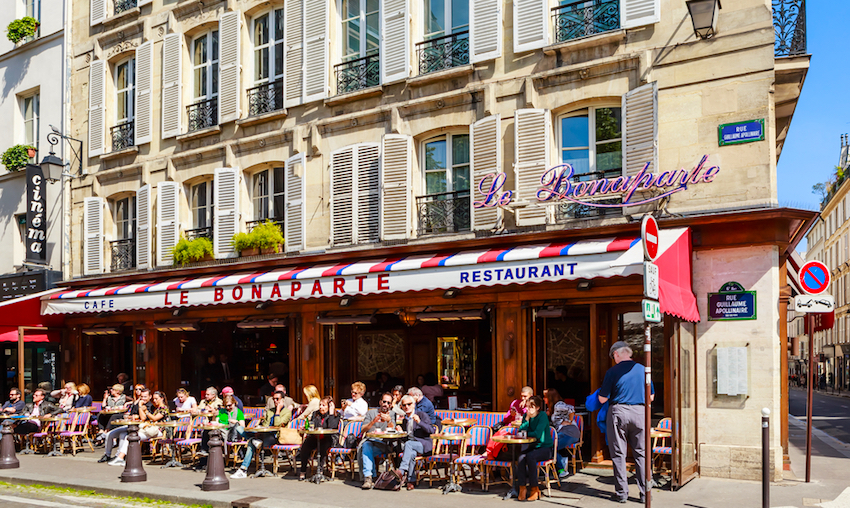
For a less visible, but just as
intellectually authentic, stroll down
the rue
Bonaparte and
try the Café
Bonaparte,
also formerly patronized by the artists and poets
who are now more likely to be serving in the cafés
than frequenting them. |
|
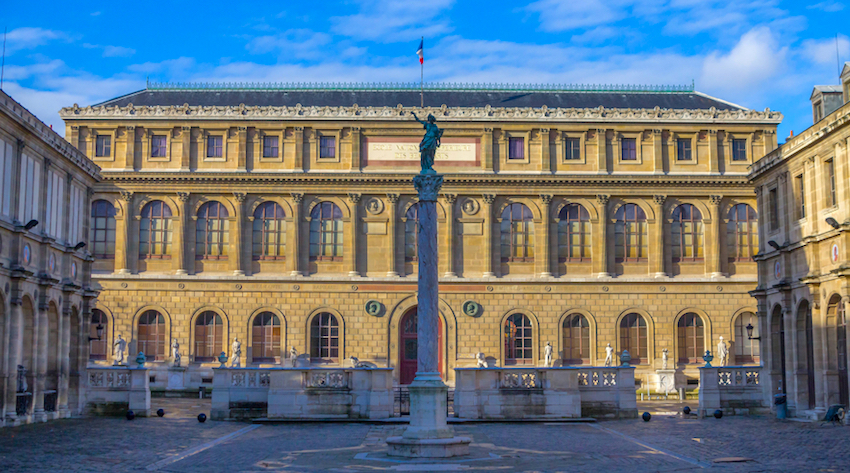
If you continue down the rue Bonaparte you will eventually see the Ecole des Beaux Arts on your left. This is the historic School of Fine Arts in Paris through which many of the great names in art history passed before anyone knew them. At the turn of the century, this was the most prestigious art academy in the world. While it maintained a stiff and traditional method of training, the rigorous program was where many young painters learned the techniques they later earned the right to break. Gericault, Delacroix, Fragonard, Ingres, Moreau, Degas, Monet, Renoir, and Sisley were some of the early masters to graduate form the school. While the school may conjure references to the establishment and conservative art, it was actually founded on a social theory which invited art students on merit alone and not social standing. If you continue, turn right and make your way up the rue de Seine you will see most of the high-end art galleries specializing in 19th and 20th century masters, prints, and photographs. If you feel like splurging on a small Vlaminck , or Matisse Print, or a Picasso sketch, this is the place. If not pick up a postcard from one of the bookstands alongside the river. As you walk back up, there is a very nice bistro on the corner of rue de Seine and rue Callot for those who need a break. The rue de Seine is also lined with small restaurants, bars and hotels as you near the Blvd. St. Germain. |
|
For a more touristy, noisy walk, turn on the rue Buci which has a couple of good cafés and a Taschen bookstore which is worth visiting for cheap, high-quality art books, and good looking art students. Right across the street is a funky café which appears to be modeled on some sort of former brothel-red walls, etc. There are no prostitutes to be found, but the coffee isn't bad. The rue Buci turns into the rue St. Andre des Arts, which is a lively street full of sandwich shops, creperies, bars, restaurants. It must be somewhat obvious by now that it is unlikely you will leave the neighborhood without overeating or getting drunk. Give in, I recommend both. Right at 13 rue de l'Ancienne Comédie you will find the legendary Café Le Procope, which claims to be the oldest café/restaurant in France, founded in 1686. If that's not good enough for you, Volataire, Danton, Hugo, Balzac, Rousseau, Benjamin Franklin and Thomas Jefferson all hung out here (at different times we hope because service can be disfunctional). The interior is stunning, and when you arrive from the airport late and step outside after a quick shower for a bite to eat, this place will remind you why you just flew 4000 miles on your overextended credit card. There is a special menu for 45 euros which is a good solution. A better solution is to go to the restaurants page and find one that is not mentioned in every travel guide ever written. Then on the way to dinner peak into the Café Le Procope in tribute to all the famous people who have eaten there and maybe you will run into someone from your neighborhood. |
|
In general, my advice it to avoid restaurants with
big menu specials on colored cardboard, and by all
means NEVER be coerced into entering by a
fast-talking, grinning, multilingual "patron".
This is a personal rule, but if a restaurant has
to plead with me to enter and offer me nasty
liqueurs as a bribe, I don't want to eat there.
The people who stand in restaurant doorways and
try to "snag" tourists are paid to do that. They
count on those of you who are too polite to refuse
their enthusiasm. Do not start a conversation
about your home state or whether you like grilled
fish, or state your nationality--- the more you
say, the harder it is to escape. Be rude, you are
in Paris after all! When in Rome… |
|
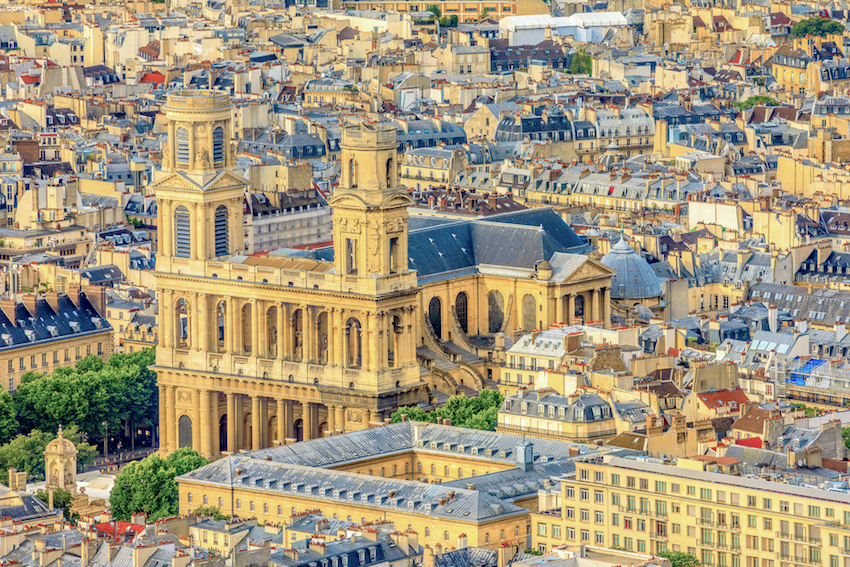
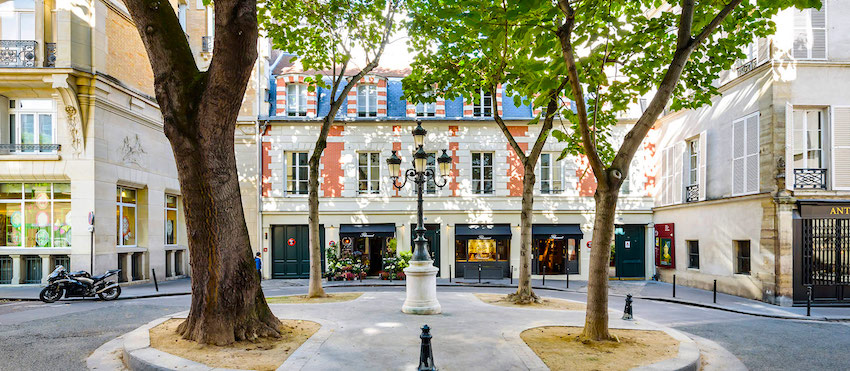
Another focal point in St. Germain is the St. Sulpice church. Organ concerts are performed at the St. Sulpice, mostly works for the Organ. On Sundays you can actually climb the stairs and find yourself "inside" an organ with about 7000 pipes going full blast. Try to get there around noon to be included in this, or arrive at 10:30 if you are simply interested in the public mass. The organ was considered to be one of the best three in the French Kingdom. It was rebuilt to accommodate more modern technology without altering its historic design. It is still one of only three "100 stop" organs in the world. (the other two are in Germany and England) The church itself faces the Square St. Sulpice flanked by some of the priciest real estate in Paris (in other words, if you live here you are lucky). Both Baudelaire and the Marquis de Sade were baptized in the church, which is an amazing thought in itself, and makes you wonder how effective that little ritual was in making them holy… The Square is a great place to sit down or lie on a bench near the fountains and cool off during the hot summer months. It attracts musicians and street performers who are sometimes quite good. |
|
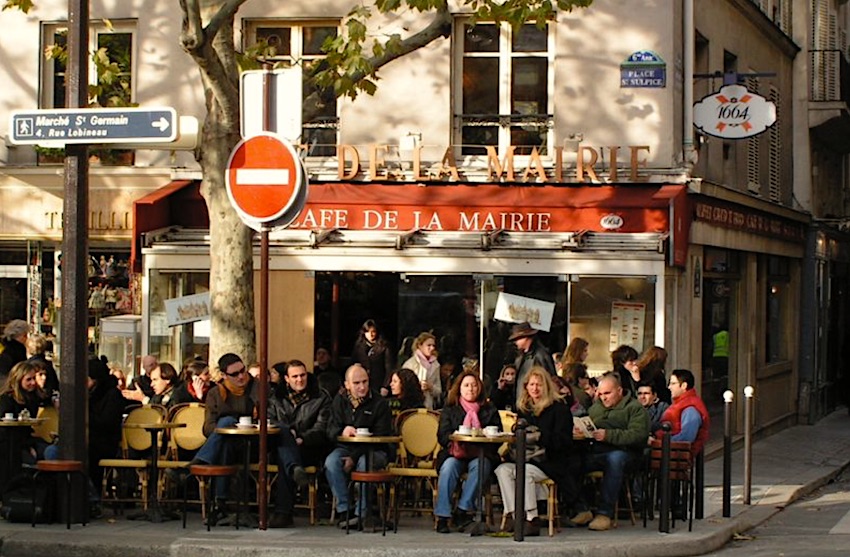
If you want to go to a real non-touristy no frills Paris Cafe go to Cafe de la Mairie right on the square which was one of my primary hangouts. Right next to the cafe is the small rue des Cannettes which has a number of nice little restaurants, cafes, and a brewery. That whole little section which includes rue Guisard, rue Princesse and rue Mabillon seems to have more than its share of good food and nightly activity. Among recommended restaurants are L'Enfance de Lard, Chez Henri (eat here!), Chez Georges, and whatever the name of the Italian restaurant is on rue de Cannettes that is closest to the square. Normally I remember to take a card but a guy had a heart attack and was taken out on a stretcher and it sort of distracted me from my task. I am sure it was nothing in the food that caused it. |
|
The Rue Bonaparte leads off the square and is known for cafés and restaurants and is worth taking a stroll along. For those interested in the great Romantic painter Eugene Delacroix, the Musee Delacroix is filled with memorabilia, sketches, drawings, furniture and famous correspondence from the painter's life. It was Delacroix who painted the frescoes in the nearby church. Delacroix's greatest works are to be found in museums throughout the world, but his most celebrated canvas, Liberty Leading the People, hangs in the Louvre. The small Delacroix museum is situated in a courtyard with a garden and is another place to escape the noise and heat while discovering something of the private life of one of the world's great painters. It is located at 6 rue de Furstenburg and is open Wednesday to Monday, from 9:30 a.m. to 5:30 p.m. |
|
Don't forget the Marche Saint-Germain which is more mall than market but still worth a visit if you like to look at food. There are a number of gourmet and specialty shops (including a Greek shop) a few restaurants, some clothing shops, you know, like a mall. It is right around the corner from St Sulpice Square off Rue Mabillon and very close to Blvd Saint Germain near the Odeon Metro station at 4 Lobineau. |
|
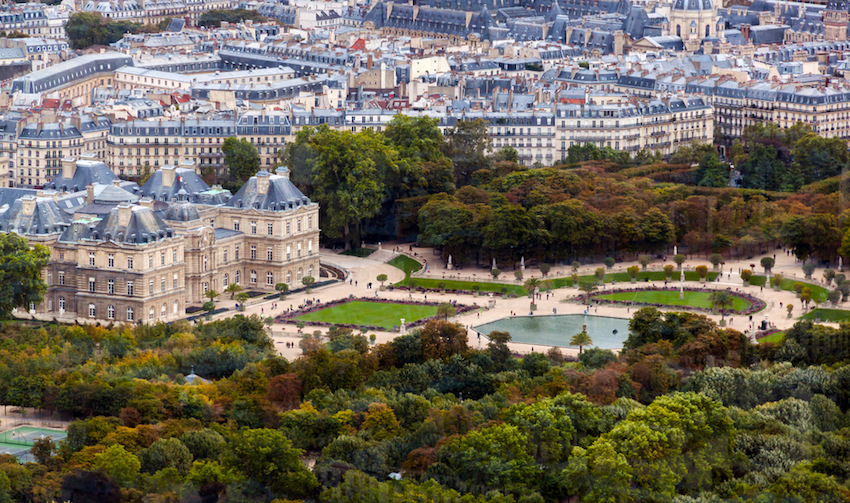
If the weather is nice, take a break and
wander through the beautiful
Luxembourg
Palace and Gardens.
After a horrific shopping spree in the
multitudinous shops of St. Germain, this is an
ideal place to find a chair by the main fountain
and lounge in the sun. There is another fountain
on the southeast end of the park, which is covered
in Ivy and is more private. Certain areas are also
reserved for children, with swings,
merry-go-rounds and ponies for rent. The grass is
accessible in some spots, but not in others, but
bicycles are not allowed. (unless you walk them)
The gardens are actually owned by the French
Senate, which is housed in the elegant Chateau.
This explains the somewhat rigid feel of the
park--- lots of rules written on signs, but is
apparently the price we pay for having such
cultivated aesthetics, the flowerbeds which are
rotated at a stunning rate, the groomed perfection
of the trees and shrubs, the lack of any garbage.
As a form of resistance, it will appear that every
teenager in Paris has chosen this spot to make out
in public. If you are a puritan type, and easily
distressed by such public displays of affection, I
recommend you stay in your hotel room and hide
under the bed. We have always been told this is
the city of romance--- if you can't kiss here,
where the hell can you? |
|
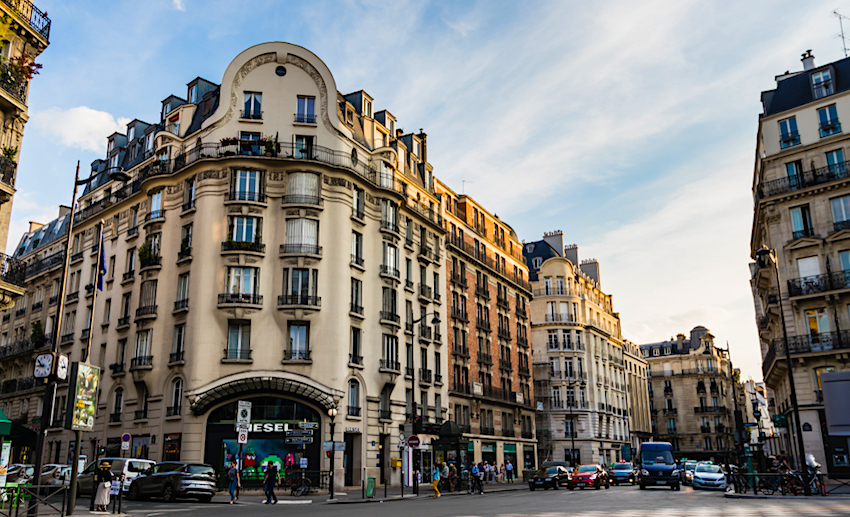
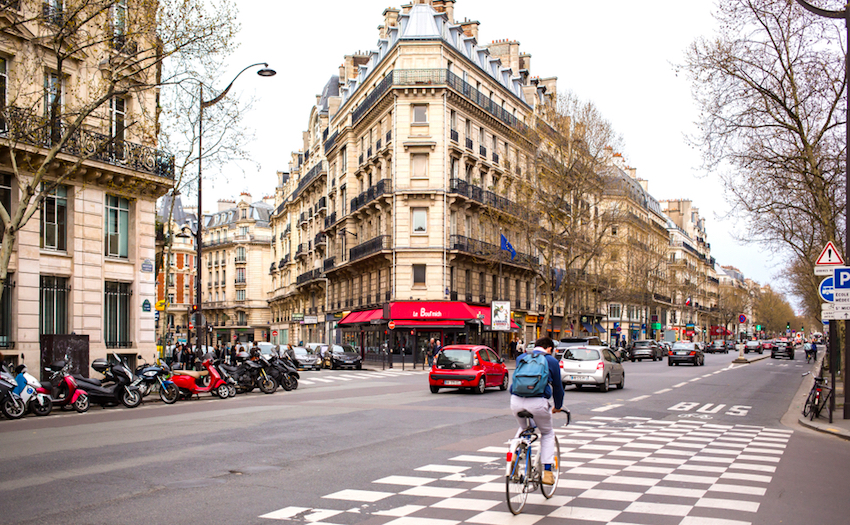
St. Germain is bisected by the Boulevard St. Germain, which serves as the central axis of the area running roughly parallel to the river. Most of the above mentioned sights are within five minutes walk of the Boulevard. Because it would be impossible and somewhat pointless to list all the interesting spots along this long, broad and colorful boulevard, I simply recommend you follow it's entire length, starting at the national Assembly and ending at the Institut du Monde Arabe on the other side of the left bank. It's a long walk, but you are sure to be distracted in the best possible manner along the way. Also on the Boulevard be sure to stop in at the tourism office for Brittany where you will see their incredible collection of sardine cans. You can buy them (with sardines of course) and you too can have a sardine collection that will impress your friends who are probably ignorant of the large variety of sardines that exist in Brittany. I bought a dozen or so cans and besides being beautiful they are quite good. Better than any I have eaten in America. (Since my last trip to Paris the tourism office has closed but there is a shop that sells products from Brittany including the sardines in the artistic cans. L’Épicerie Breizh Café at 111, rue Vieille du Temple (3rd). Take the Métro to Filles du Calvaire or Saint-Sébastien- Froissart. It is actually an anex to a cafe of the same name that Andrea found on David Lebovitz Living the Sweet Life in Paris) Stephanos Papadopoulos |
Hotels in Saint Germain |
|
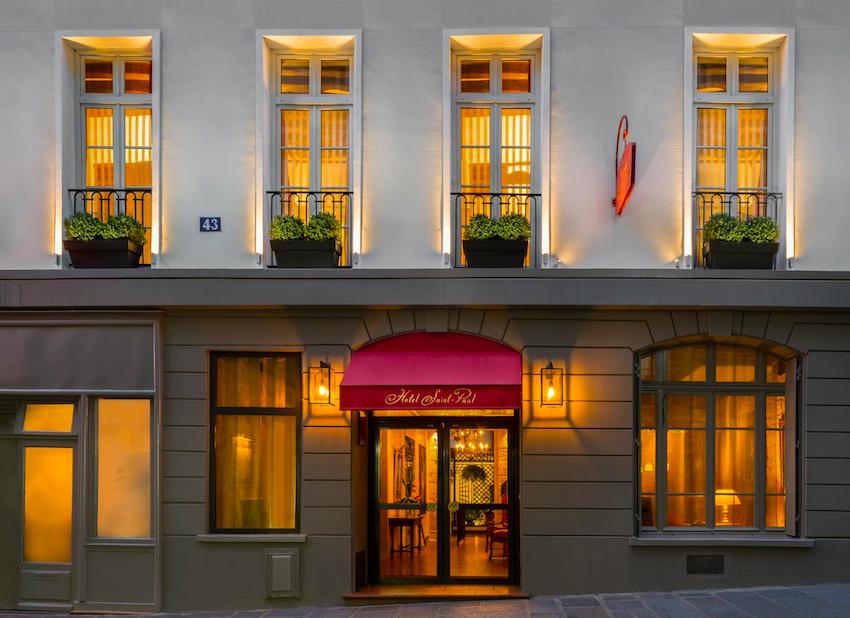
Saint Germain is one of the best areas to stay in. If you are thinking about your budget then stay where we did, at the simple Hotel Recamier which is right on Saint Sulpice Square. Get a room overlooking the square and the famous church and except for an occasional foray to see the sites you will never have to leave the neighborhood. Another nearby economy hotel Hotel du Globe is housed in an 18th century, typically Parisian building, close to the Marche Saint Gerrmain and the boulevard. The 3-star Odeon Saint Germain is in a building dating back to the 16th century within a stone’s throw of Odéon, Saint-Germain des Prés and the Luxembourg Garden. The 3-star Hotel Madison is right in front of the Saint-Germain-des-Prés Church within easy walking distance of the Louvre Museum, the Orsay Museum, the Seine River, and Notre Dame de Paris Cathedral. More upscale the 4-star Hotel de Buci is located between the Rue de Seine and the Boulevard Saint Germain. It offers comfortable rooms with free Wi-Fi internet access. The 4-star the Hotel La Villa Saint Germain is a 17th century mansion decorated by famous architect J.P. Nuel. The Grand Hotel des Balcons, is a nice two star just off the Luxembourg Gardens, still a family owned, clean as a whistle and great breakfast. Good wifi. Helpful staff. The rooms can be small but that is not unusual. The charming 4-star Hotel St. Paul River Gauche on rue Monsieur le Prince just off Luxembourg has lovely rooms and a great staff. |


Help Support Matt's Paris Guide
Do you enjoy using my site? Have you found it entertaining as well as useful? If so please show your appreciation by booking hotels through the links found on my Hotels Page. The small commission I make on the bookings enable me to keep working and in most cases you won't find them any cheaper by searching elsewhere. You can
also book at Booking.com's Paris Page and they give me a small percentage on each booking. If you are appreciative of all the free information you
get on my websites you can send a donation through Paypal.